SEO is still an incredibly important tool to make your business/organization stay top-of-mind for your potential clients.
In an increasingly crowded online climate, effective SEO is critical now not only for your website but for any digital platform where your brand lives: Social media (especially YouTube), Google Maps location listings and any other place you may have a presence.
The good news is that large-language modeling AI apps (artificial intelligence), are leveling the playing field in terms of what determines quality, high-ranking SEO. Long gone are the days of keyword stuffing and other nefarious tricks that you could use to quickly climb the ranks in Google’s search results.
Even keyword-focused optimization is starting to wane as AI becomes better at interpreting human languages in a more holistic way that “reads between the lines”, flagging any content that appears to be set up “unnaturally”.
That isn’t to say that choosing the right keywords isn’t important, but how you convey your information is becoming just as important as what you are saying.
Appearing prominently in Google’s search results is still the “gold standard” for success in SEO, and it is increasingly important to be mentioned in citations when the answers are being delivered by AI tools such as ChatGPT and Gemini.
To make sure your company/organization continues to attract the clients you want, the following tips can maximize your SEO potential.
How you convey your information is becoming just as important as what you are saying.
Write useful content that matches specific user intent
AI is getting better at figuring out how and why users are searching for things, not just what they are searching for. Even the tone you use when writing a search question for an AI chatbot will yield various results, depending on how you use it.
What this means is that AI is becoming a matchmaker between your potential audience and its search results; it is getting better at interpreting what it thinks your potential audience wants. AI (including Google’s own Gemini) has some idea of your audiences’ mindsets/personality and what their goals are based on their current and past searches. When users submit a new question, it takes all those into consideration to match with results that solve their questions in a way that is not just effective, but tailored to their perceived intent and mindset.
You can use tools such as Google Search Console, Google Analytics or paid services such as Moz or SEMRush to find out what people were searching for when they landed on your website.
The way the searches are phrased is as important as what is being searched for (keep that in mind when writing for your audience).
Once you have picked the phrases that you are the most confident and knowledgeable about, you can use those as topics to write well-structured content that will help boost your SEO.
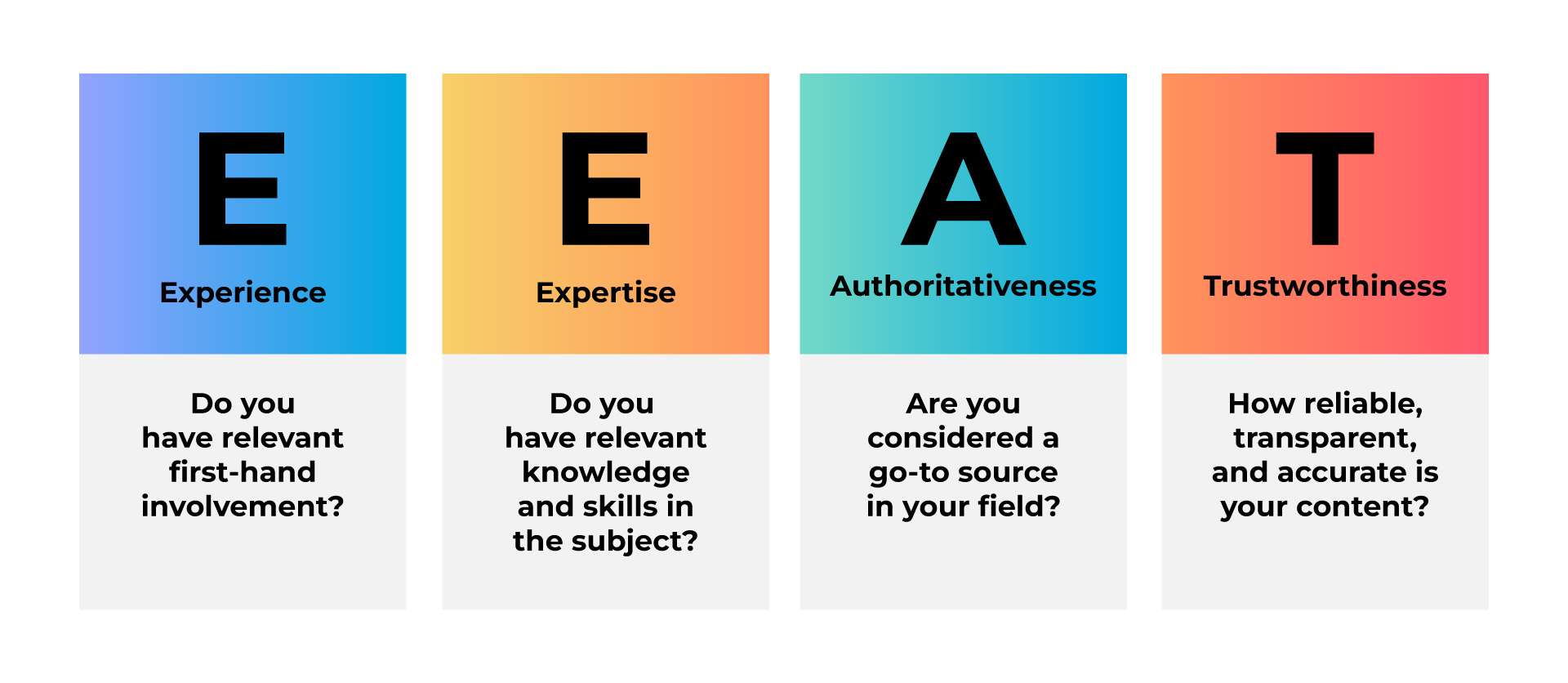
Experience, expertise, authoritativeness, and trustworthiness (E-E-A-T) signals are critical
Become an expert at what your organization/company knows, specifically, and promote that as much as possible on your website/platform. Write about what you know well, answering specific questions in just a few areas where you promote you and your company/organization as a leading authority.
You need to “pick a lane” when it comes to SEO; trying to be everything to everyone within the general realm of your industry is just not possible in SEO, especially in sectors where a few, well-known leaders have large advertising and social media budgets that allow them to overshadow their competition. You are not Amazon, Apple or Microsoft… nor should you try to be.
Experience: Do you have relevant first-hand involvement?
Expertise: Do you have relevant knowledge and skills in the subject?
Authoritativeness: Are you considered a go-to source in your field?
Trustworthiness: How reliable, transparent, and accurate is your content?
Specializing your content to certain avenues within your industry is a much more natural way of getting your “foot in the door” for high SEO rankings in Google.
Focus on writing for longer phrases (“long-tail” keywords) that are specific enough that search results will already skew in your direction if someone searches for them. Then start getting into the habit about writing for those as often as possible when you have something that will be insightful and useful for your target audience. You can use free resources such as Screaming Frog to analyze your competitors’ websites to see what long-tail keywords they rank for, and what your site ranks for.
Know who your direct competition is, at your level, and outsmart them with your most specialized knowledge.
Write professionally; stay organized
AI is getting better and better at detecting how people write and how they use language to convey information.
Always write about a topic as if you are trying to attract the kind of client that you want. Be professional: make sure your writing will be understood by your audience, and write as if someone is paying you to learn the information you are giving them.
Users want clear, concise, well-organized answers to their questions that they can find quickly. If you are writing about the same topic multiple times, be sure your content doesn’t answer the same questions over and over.
Keeping your tone conversational will help match the conversational tone most users have when asking questions to AI bots (a search method that is starting to overshadow traditional search engine searches).
Brand presence
When you become an expert at something, your brand commands a larger presence. When you have a large base of specialized knowledge ready for Google to review (i.e. you write about it often, and with authority and clarity) you can confidently advertise your brand across various platforms. You will naturally become more prominent as your brand/online platforms emerge as leading destinations for your intended audience.
This is the time when paid strategies (e.g. targeted advertising) are best implemented to augment the SEO success you’ve achieved by being a leading expert.
Peter Caunitis is a web developer with 20 years of experience. His expertise is in WordPress theme development and front-end functionality for government and association websites. He ensures that his websites are structured with best-practice technical optimizations and WCAG/AODA standards. This technical knowledge—paired with his background in communications, strong copywriting skills, and training in user experience design—are an essential combination that has resulted in well-rounded SEO health for dozens of our clients’ websites.